
This is an attempt to change my writing style. Not sure what it will become, but feedback and criticism is encouraged.
Have you ever noticed that those who live within the same neighborhood, have the same income level, or even have the same social circle tend to mimic each other? Their behavior reflects one another, and as some may say your circle reflects you. This is mimicry!
Mimicry mirrors unconsciously or consciously the behaviors of others. This can include mannerisms, verbal and nonverbal expressions, gestures, speech, patterns, and other behaviors to chameleon others. There is nothing authentic about mimicry, yet it’s natural human behavior.
I came across mimicry behaviors when studying internal demographic migration. In, learning how to build a framework to migrate low-income populations within a municipality into middle, and high-income populations. I learned that there are behaviors that concentrate within certain neighborhoods, sub-population or subclasses and to shift a population into upward mobility the framework must first introduce sociogenic patterns for them to mimic.
The framework must first build a bridge that teaches behavior patterns between the two income levels that overcomes classism conditioning, or the conditioning of classism. I do understand that classism is systemic, and yet many programs and organizations that work to combat community issues completely lack acculturation.
Acculturation is the missing link of most community impact programs, rather run by the county or municipal government or by a nonprofit organization working to positively impact neighborhoods. Without acculturation, the program will ultimately fail. When I speak of failing, I speak of a program that operates for a decade or more on the burden of taxpayers, yet the outcomes don’t change.
There are many examples of these failures. Each election season, politicians introduce new programs to address the same community issues that have persisted for decades, often with little or no meaningful progress. Those of us who rely on logical prescience can anticipate these failures because the programs lack acculturation.
Election season is upon us! I’m sure you and I both have noticed politicians announcing to the public new programs and initiatives at the expense of taxpayers to build their reputation and gain voter recognition. If you look close at the programs they announce none of them include acculturation, so we can predict that they will fail and the politician will use the same issue to get reelected.
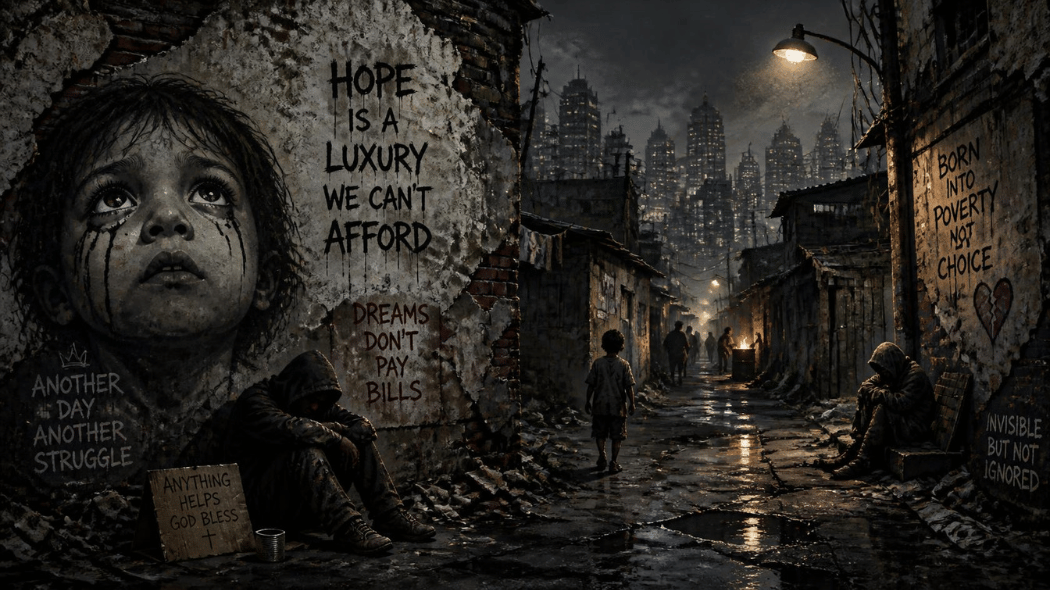
The purposeful lack of acculturation in community programs that directly serve disadvantaged populations has led me to believe that society itself doesn’t want income mobility and migration. Then I asked myself, why? Is poverty a sociogenic illness?
Sociogeny is a concept coined by Frantz Fanon, in his 1952 book; Black Skin, White Masks. Fanon explains that non-white people are often forced to mimic white culture, language, and behaviors to survive and gain acceptance in a racist, colonial society. This form of mimicry directly correlates to classism and poverty, as people who live in poverty are often forced to mimic others to be accepted.
Fanon explored the causes of mental illness, psychological trauma, and alienation as factors of social, economic, and political structures; specifically, racism and colonialism in addition to biological and individual factors. The understanding of Fanon’s concept of sociogeny ushers in clarity of why generational poverty causes brain damage; sociogenic brain damage.
Fanon described how colonized people were falsely pathologized as violent, deceitful, lazy, etc., by systems who refused to accept the impact of oppression, poverty, and racism have on the human body and mental health. In 1952 Fanon understood the impact of poverty on human development and mental health; which psychologists and researchers are still studying today. It’s continuing to be studied today because the damage is societal, and until society changes sociogenic illness will continue transmission.
Sociogenic illness is transmitted through mimicry as poverty causes depression, anxiety, stress, and other mental health issues through social contact. It explains why connected people develop shared, often involuntary behaviors that mimic each other.
Even though research has established a bidirectional causal relationship between poverty and mental health, community leaders are focused on providing solutions for mental health instead of utilizing Fanon’s research of addressing the societal issues to halt the continued sociogenic transmission of illness.
Stay informed and join us in advocating for a sustainable future for all. For more information contact: Robert Farris, Ed.D at info@conimby.org (1) 513-586-6134 or visit: www.conimby.com