The concept of the government providing a basic income to all members of society is often associated with the Sir Thomas More book; Utopia. Which was first published in Latin in 1516 and is considered a work of fictional social political satire.
The concept was later discussed by Thomas Paine; who proposed a form of basic income from a national citizen’s dividend funded from a tax paid by private landowners, in his 1797 pamphlet Agrarian Justice.
Then there was Thomas Spence, who many have called a radical for his thoughts on establishing contained communities in which the parish owned all land and rents funded public needs with the remainder distributed equally among every resident of the parish.
And let’s not forget the proposal for guaranteed income from Dr. Martin Luther King, Jr., in his book; Where Do We Go From Here: Chaos or Community? published in 1967. Many believe Dr. King’s change from advocating for nonviolence to advocating for a economic justice with a Freedom Dividend focused on a guaranteed annual income as the solution to eradicate poverty with the Poor People’s Campaign, is what got his assassination.
What is Universal Basic Income?
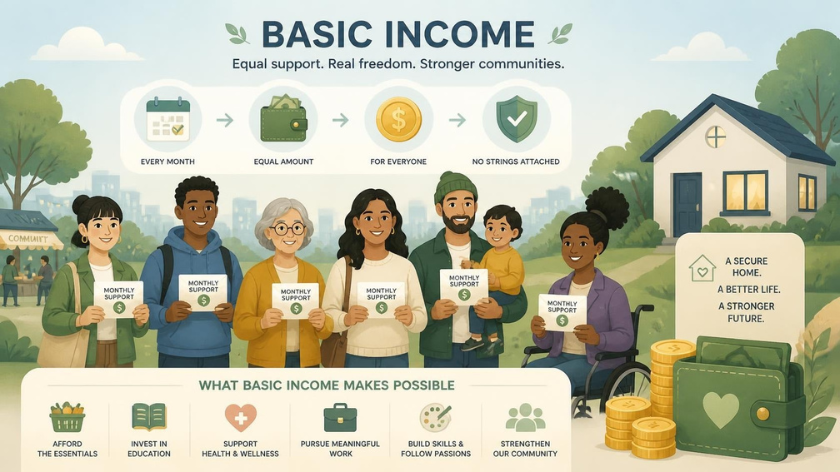
Universal Basic Income is a proposal in which all people would receive a minimum income in the form of an unconditional monthly payment, meaning without restrictions; funded by the government, meaning taxpayers.
What is Public Resource Dividend?
Public Resource Dividend is the concept of an annual dividend payment from a government owned enterprise that provides a citizen dividend to eligible participants. The Alaska Permanent Fund is the ideal model of the public resource dividend as it’s the only real-world example of basic income.
A government owned enterprise, which could be state or municipal owned, is a business created and owned by a government that engages in commercial business activities. An example of this is The Cincinnati Southern Railway Trust, which is a government owned enterprise funded from the sale of the Cincinnati Southern Railway in 2023, and seeks to fund infrastructure improvements.
Both forms of basic income are social dividends and are features of socialism, yet they differ in a very important way. Universal Basic Income isn’t taxable, yet Public Resource Dividends are taxable reported on the residents’ 1099-MISC as other income. One increases the burden of government as it’s dependent on other taxpayers, and the other lessens the burden of government.
With the growth of artificial intelligence, automation, and income inequalities, the concept of basic income has gained renewed interest. Yet, I believe there is a better way to do this by incorporating many of the best practices from several basic income concepts into something that lessens the burden of government and cover the expenses of the those in need.
Stay informed and join us in advocating for a sustainable future for all. For more information contact: Robert Farris, Ed.D at info@conimby.org (1) 513-586-6134 or visit: www.conimby.com